


The Depreciation Advantage: From Paper Loss to Real Wealth
At Spartan, we believe informed investors are empowered investors. Understanding depreciation reveals the full picture of your returns, not just cash flow, but tax-sheltered wealth accumulation. It means earning strong cash returns while significantly reducing the tax owed on them, year after year.
What Is Depreciation?
In the eyes of the IRS, physical assets wear out over time. Buildings deteriorate. Roofs age. Doors corrode. Depreciation is a non-cash tax deduction that lets you recover the cost of an income-producing asset over time. You don’t spend any additional money; you simply reduce your taxable income on paper. For Spartan investors, this shelters a significant portion of annual cash flow from taxation.
As a result, real estate investors can deduct a portion of a property’s value each year as a “paper loss,” even while the property may be appreciating in real-world market value.
This is the core paradox, and the core power, of depreciation: your property goes up in value while your taxable income goes down.
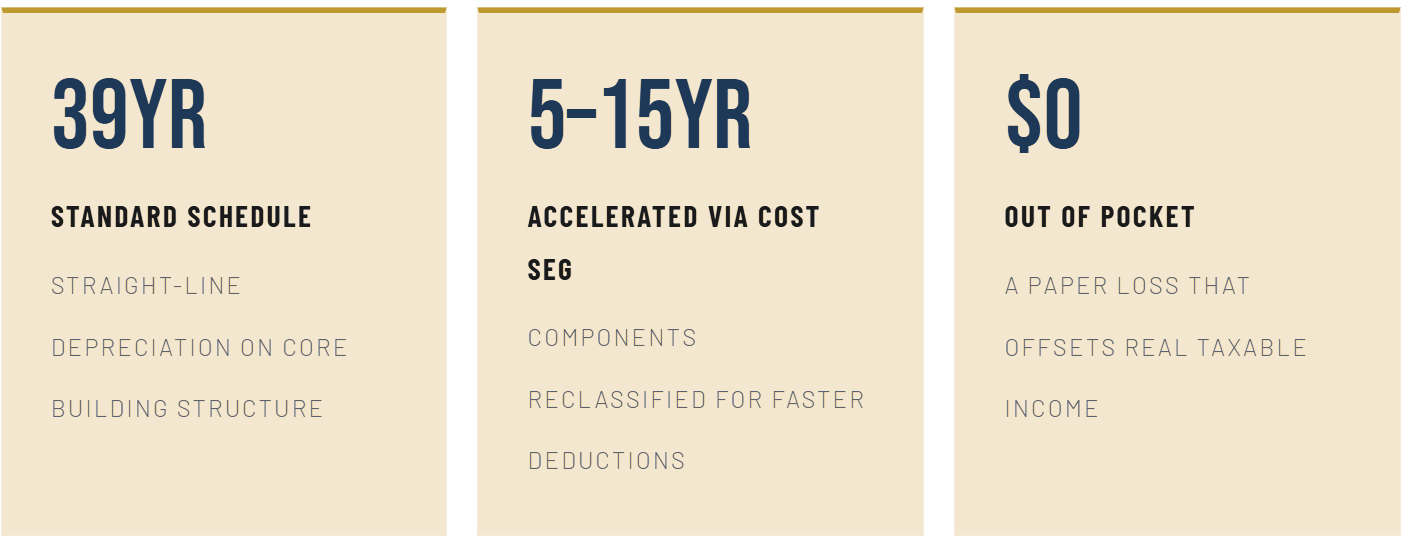
Depreciation doesn’t cost you a dollar out of pocket. It’s a non-cash deduction that offsets real income, making it one of the single most valuable tools in a real estate investor’s arsenal.
The IRS classifies commercial real estate, including self-storage facilities, under 39-year straight-line depreciation. That means if you invest in a facility with a building value of $1,000,000, you can deduct roughly $25,641 per year for 39 years, regardless of whether the property is appreciating in market value.
Key Point: Land is never depreciable, only the structure and qualifying improvements are eligible.
On its own, straight-line depreciation is valuable. Structured properly, it becomes transformational.
Cost Segregation: The Spartan Edge
Standard 39-year depreciation is a baseline, not a strategy. At Spartan Investment Group, we employ cost segregation studies on our self-storage acquisitions and developments to accelerate depreciation and push substantial deductions into the early years of ownership, when the tax benefit matters most.
A cost segregation study conducted by a certified engineering team breaks the property into individual components, each with its own shorter depreciation life:
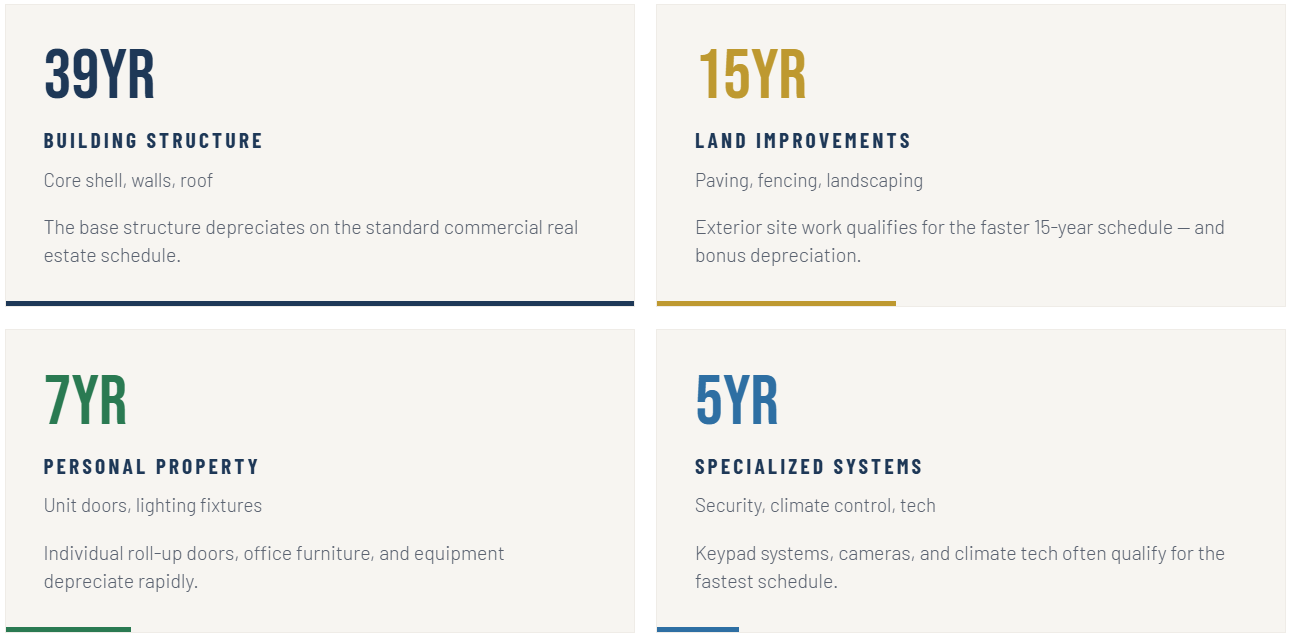
When you accelerate components into shorter schedules, you’re not getting more depreciation over time, you’re getting the same deduction faster, compressing years of tax savings into the critical early period of an investment.
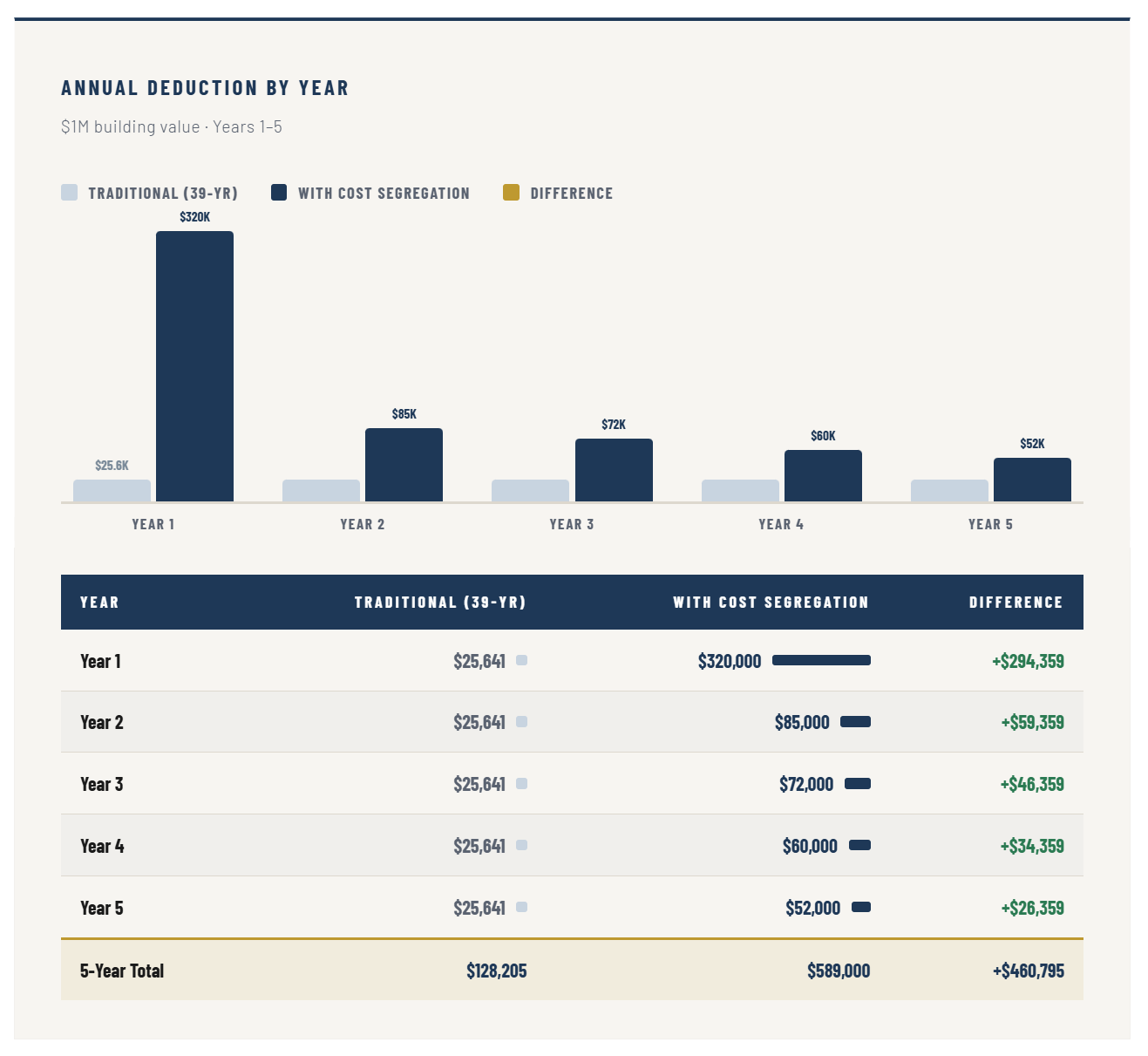
Annual Depreciation: Traditional vs. Cost Segregation
Based on a $1,000,000 building value, the difference between standard 39-year depreciation and an accelerated cost segregation strategy is dramatic, especially in the critical first years of ownership.
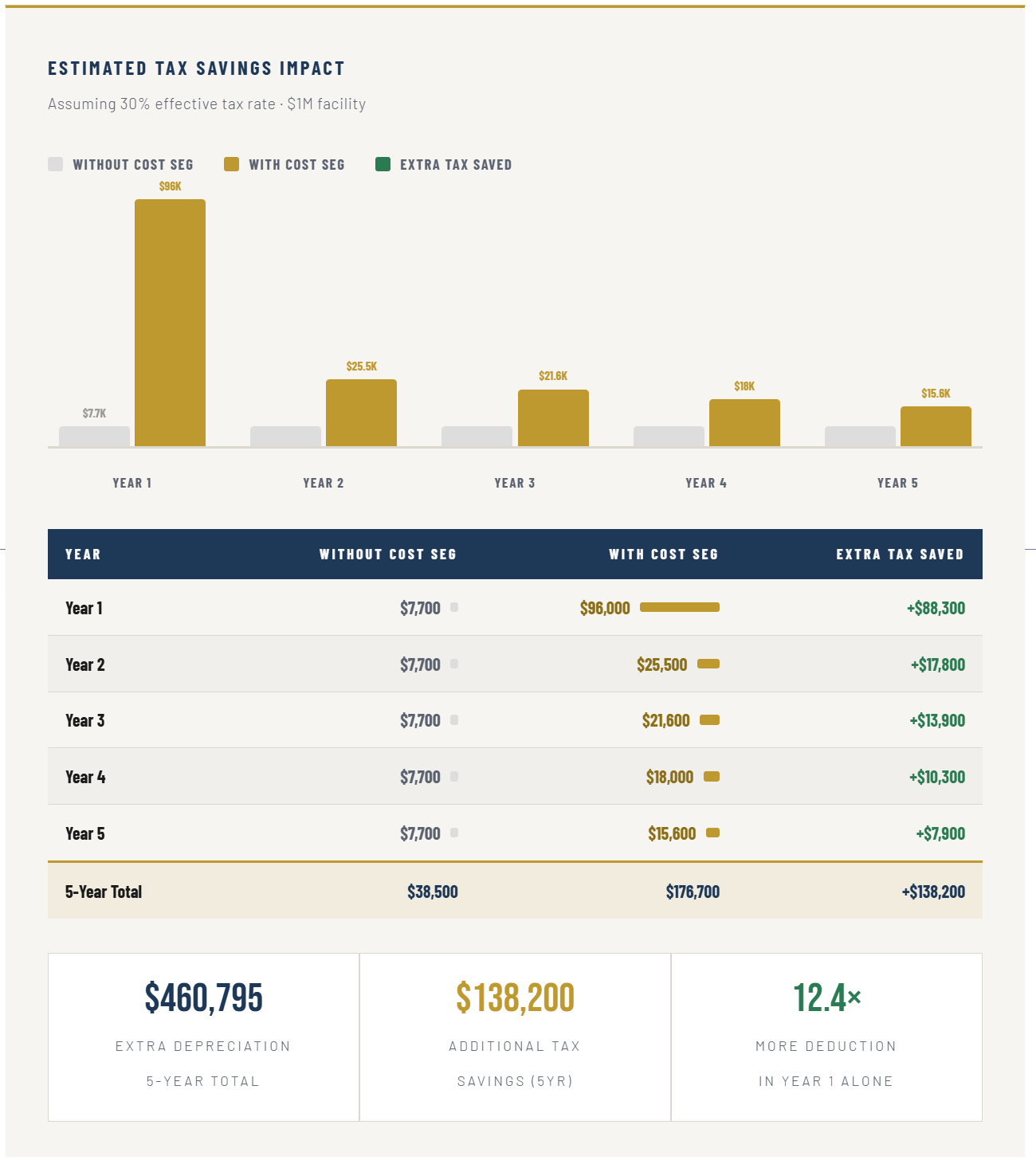
A real-world example:
Let’s illustrate with a hypothetical Spartan self-storage acquisition. Assume Spartan acquires a facility for $5,000,000. Here’s how the depreciation stacks up without and with cost segregation:
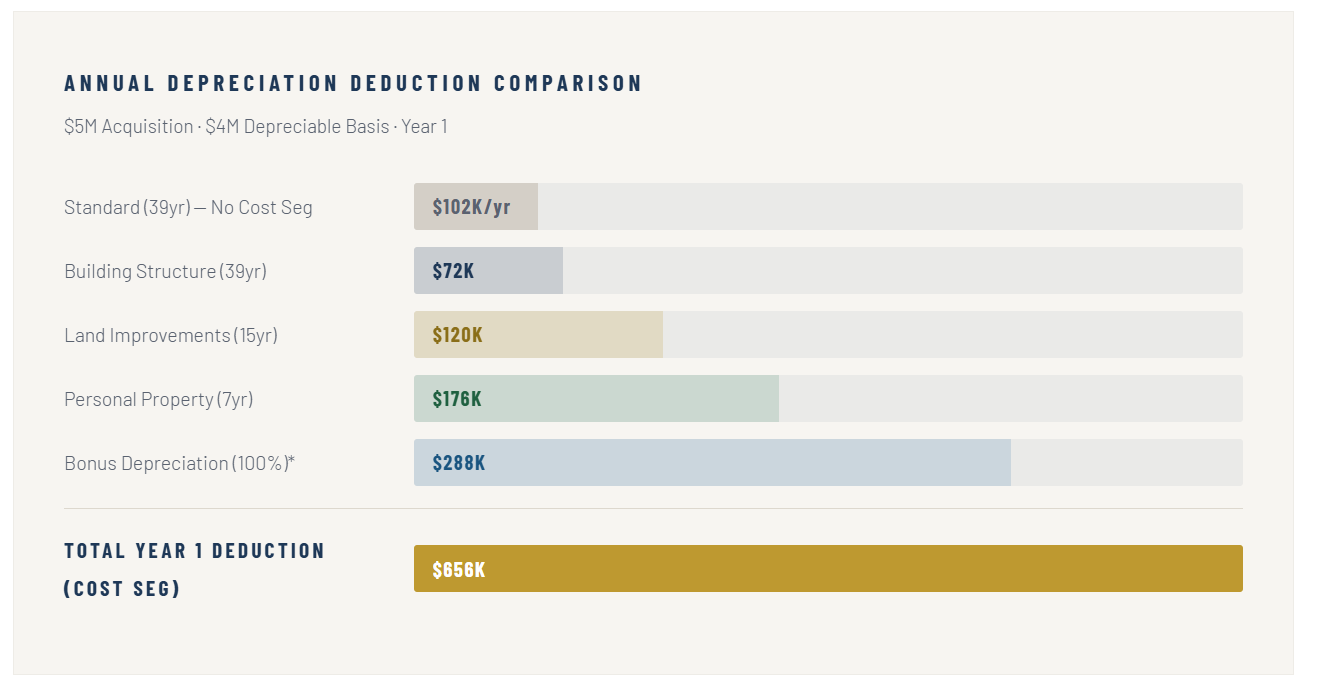
* Bonus depreciation rates vary by year. Consult your tax advisor for current rates.
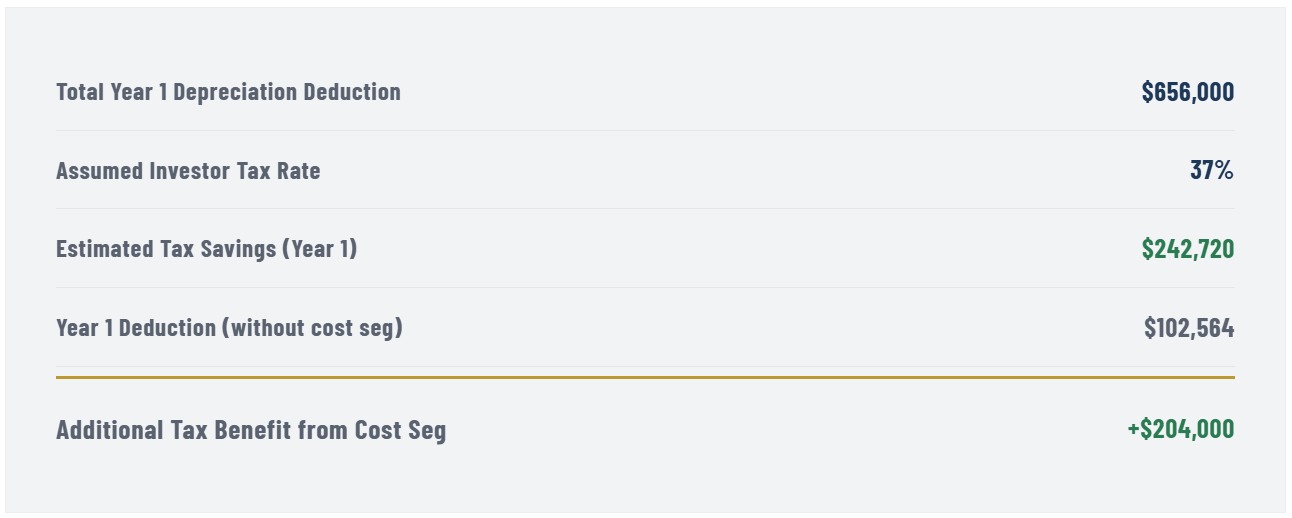
That $200,000+ in additional tax savings stays in your pocket, available to reinvest, compound, or deploy into the next Spartan opportunity.
Passive Loss Rules: What Investors Need to Know
Depreciation deductions flow through to investors as passive losses. Under IRS passive activity rules, passive losses can generally only offset passive income, unless specific conditions are met.
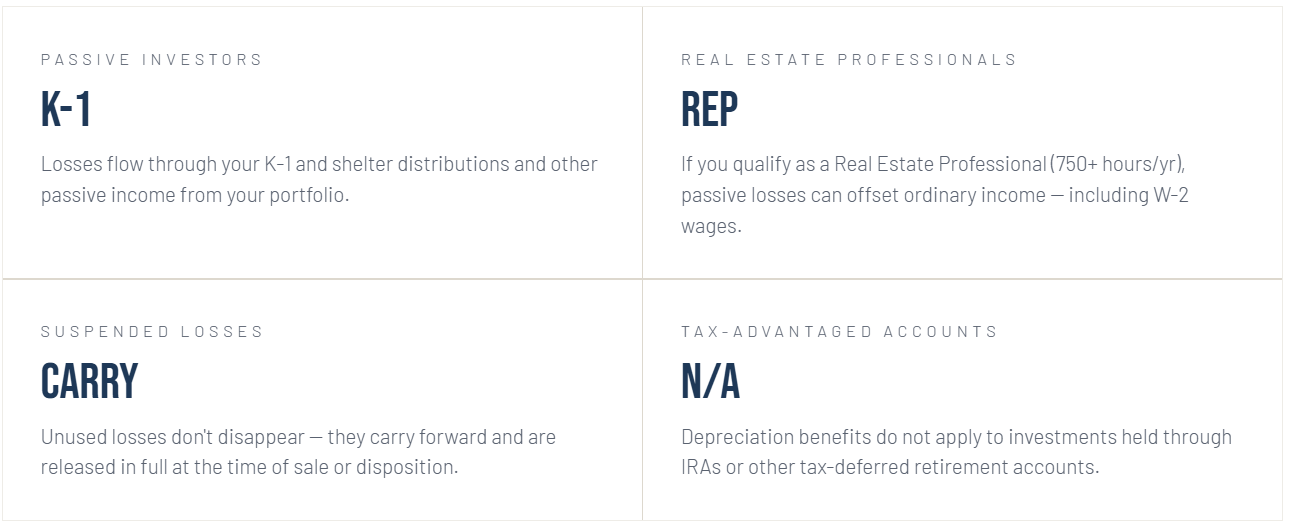
* Every Spartan investor’s tax situation is unique. We strongly encourage working with a CPA experienced in real estate syndications to maximize your depreciation strategy.
Depreciation Recapture: Plan Ahead
When a Spartan property is sold, the IRS “recaptures” the depreciation deductions taken over the hold period, taxing that amount at a maximum rate of 25%, rather than the lower long-term capital gains rate.
At first glance, this can seem unfavorable. But consider the math: you’ve been using those deductions all along at your marginal rate (often 35–37%), and recapture only taxes them at 25%. The net benefit is often positive for many investors, depending on their tax profile.
A 1031 Exchange allows investors to defer both capital gains tax and depreciation recapture by rolling proceeds into a like-kind property. Spartan actively structures exits with this optionality in mind.
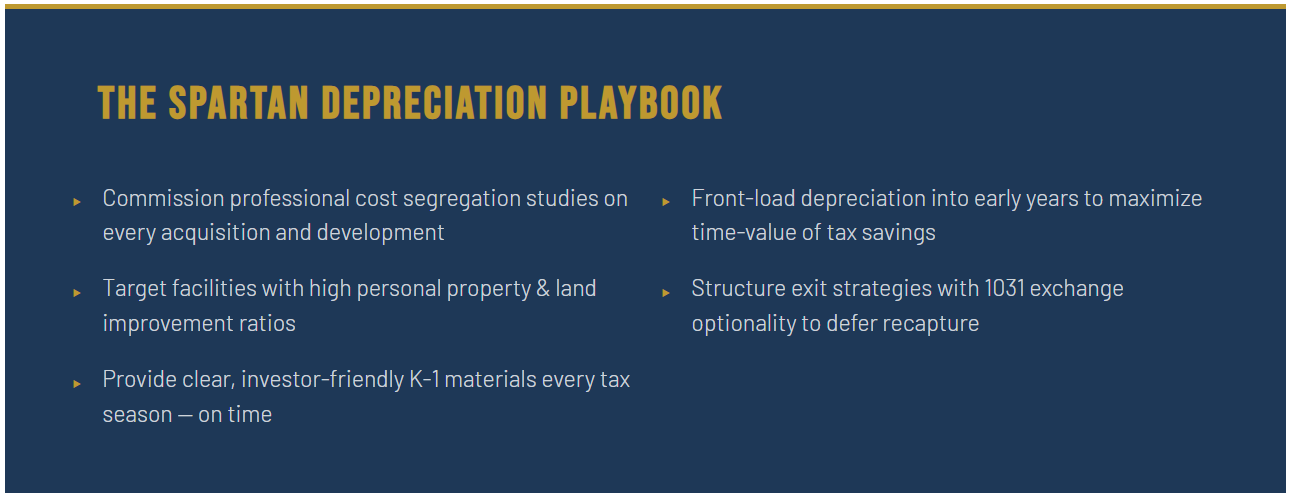
Depreciation as a Wealth Multiplier.
Self-storage depreciation is not a loophole or a gray area. It’s an IRS-sanctioned mechanism that rewards long-term real asset ownership. When layered with cost segregation, bonus depreciation, and smart exit planning, it becomes a compounding wealth-building tool.
At Spartan Investment Group, we don’t leave depreciation on the table. We engineer it into every acquisition, structure it to benefit our investors from day one, and manage it through the full lifecycle of every asset. Our mission is to maximize your risk-adjusted after-tax return. Depreciation is a core pillar of how we deliver on that promise, year after year, deal after deal.
Ready to Deploy Capital with Spartan?
Join our investor community and access institutional-grade self-storage opportunities built for long-term wealth.
Disclaimer:
This material is provided for informational and educational purposes only and does not constitute tax, legal, accounting, or investment advice. The discussion reflects general principles of U.S. federal tax law as of the date of publication and may not apply to your individual circumstances. Tax laws are complex, subject to change, and dependent on each investor’s specific situation.
Any references to depreciation, cost segregation, bonus depreciation, passive loss rules, capital gains, depreciation recapture, or 1031 exchanges are illustrative only and are not guarantees of tax outcomes. Examples and hypothetical scenarios are for demonstration purposes and should not be relied upon as projections of actual results.
Investing in real estate involves risk, including loss of principal. Past performance does not guarantee future results. Investors should consult their own qualified tax and legal advisors before making any investment decisions.