

Climate-Controlled vs. Standard Storage Units: What’s the Difference?
Why the unit behind the roll-up door matters more than most investors realize
When most people rent a storage unit, they’re thinking about square footage and monthly price. They’re not thinking about vapor barriers, HVAC cycles, or how humidity interacts with electronics, wood, and paper over an 18-month rental period. But operators and investors who understand the distinction between climate-controlled and standard self-storage units (and why tenants are willing to pay a meaningful premium for the former) have a structural advantage that shows up directly in rent rolls and exit valuations.
Climate-controlled storage is no longer a niche amenity. It is the fastest-growing segment in the self-storage industry,[1] and in an era where renters are storing increasingly high-value personal and business inventory, understanding what separates these two product types is foundational knowledge for anyone serious about the asset class.
What Standard Self-Storage Units Actually Are
A standard self-storage unit is what most people picture: a roll-up metal door, concrete floor, and a corrugated steel exterior wall separating a tenant’s belongings from whatever the weather is doing outside. There is no temperature regulation, no humidity control, and access is almost always exterior-facing, which means direct exposure to outside air every time the door opens.
For many use cases, this is entirely adequate. Seasonal items, recreational equipment, vehicles, tools, and construction materials are generally resilient to temperature swings and humidity fluctuations. Standard units also carry lower operating costs for facility owners, require no HVAC infrastructure, and command predictable if modest rents. Nationally, a standard 10×10 unit typically rents for $110 to $140 per month depending on market.[2]
The limitations become relevant when tenants start storing things that cannot tolerate environmental stress, which in today’s storage market is increasingly common.
What Climate-Controlled Storage Units Actually Are
Climate-controlled units maintain a consistent interior temperature, typically between 55°F and 85°F, and in better-built facilities, actively regulate humidity levels as well. They are almost always located inside an enclosed building with interior corridor access, which provides an additional buffer against outdoor conditions beyond what the HVAC system alone provides.
It’s worth clarifying a common misconception: climate-controlled does not mean refrigerated. These units are not cold storage. The goal is stability, eliminating the extreme high and low temperature fluctuations and the humidity spikes that cause most long-term storage damage. A facility in Phoenix in August may hit 115°F outside; a properly maintained climate-controlled unit inside that same building will hold steady in the mid-70s.[3]
Some operators distinguish between “temperature-controlled” (HVAC only) and “climate-controlled” (HVAC plus active humidity management). The terminology is not standardized across the industry, which means investors evaluating facilities should ask specifically what the system controls, temperature alone or temperature and relative humidity, when underwriting a unit mix.
Why It Matters What’s Inside the Unit
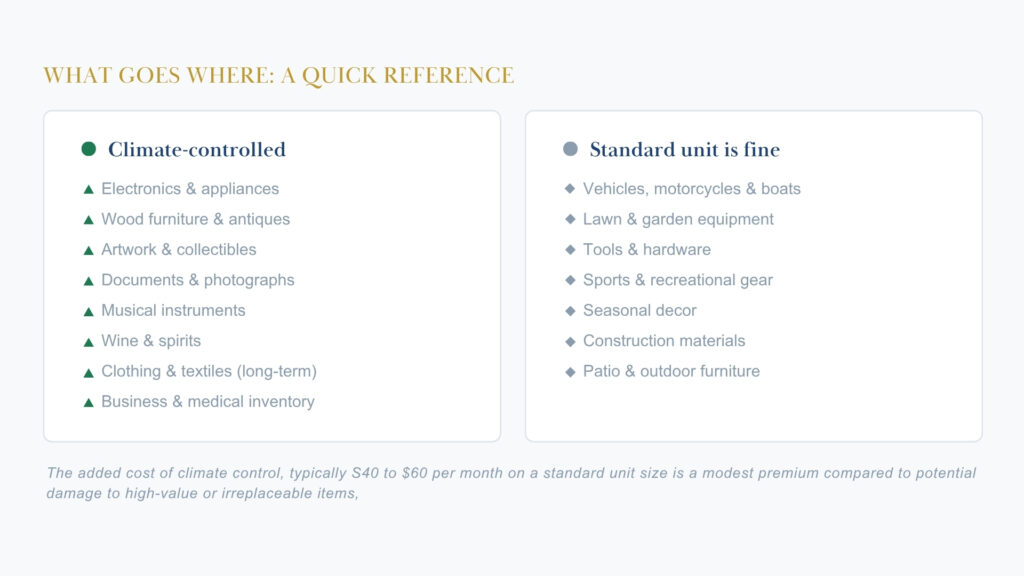
The damage mechanisms in uncontrolled storage environments are well documented. Temperature extremes cause wood to warp, expand, and crack. They degrade adhesives in furniture joints and cabinetry, damage vinyl records, melt certain plastics, and accelerate the chemical degradation of electronics. Humidity is often the more destructive force; relative humidity above 65 to 70% creates conditions for mold and mildew growth on fabric, paper, leather, and organic materials. Metal items rust. Photographs yellow and stick together. Musical instruments are particularly vulnerable, with humidity shifts causing cracking, warping, and tuning instability.[4] Thermal cycling, the repeated expansion and contraction of materials as temperatures rise and fall daily and seasonally, compounds both problems over time, even in climates that don’t reach extreme temperatures.
For tenants storing electronics, antiques, art, wine, documents, pharmaceutical inventory, clothing, or business merchandise, a standard unit is not the appropriate product.
The Rent Premium and What Drives It
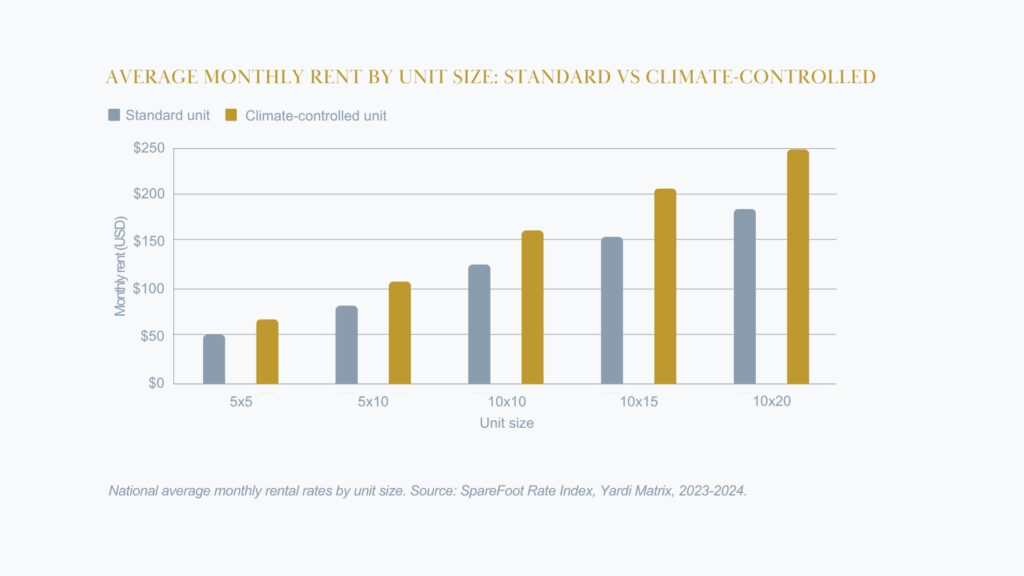
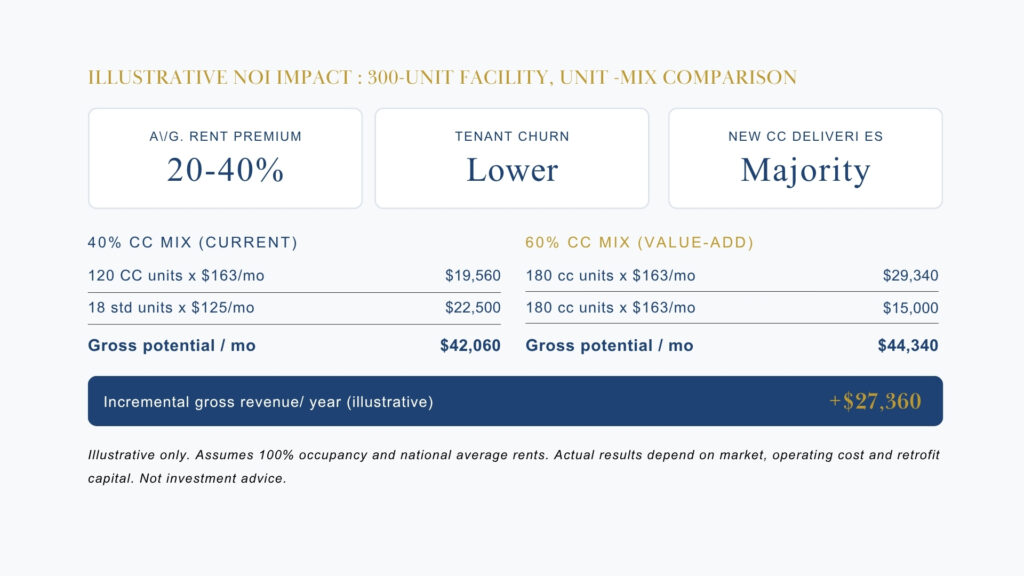
Climate-controlled units typically command rental premiums of approximately 20 to 40% over comparable non-climate units in the same market, with premiums reaching higher in regions where extreme heat or humidity makes climate control functionally necessary rather than simply preferable.[1]
At the national average, a standard 10×10 unit rents for $110 to $140 per month. A climate-controlled 10×10 in the same facility commonly rents for $150 to $190 per month.[2] On a 300-unit facility with 40% climate-controlled product, even a conservative 25% rent premium on those units translates to a material improvement in gross potential revenue. Because climate-controlled tenants tend to store higher-value items and remain longer, that premium is typically more durable than standard unit revenue.
Tenant retention is a key part of the economics. Customers storing furniture from an estate, business records, pharmaceutical samples, or expensive musical instruments are not casual renters. Moving a storage unit costs time, money, and the risk of damage to irreplaceable items. That behavioral inertia produces lower churn, which in turn produces more predictable cash flow and lower marketing and administrative costs associated with unit turnover.
What This Means for Investors Evaluating Facilities
The unit mix of a self-storage facility, specifically the ratio of climate-controlled to standard units, is one of the most important underwriting inputs an investor can examine. A facility with 80% standard units and a geographic profile that suggests strong demand for climate-controlled product (dense urban market, significant residential apartment population, Southeastern or Gulf Coast climate) may represent a meaningful value-add opportunity. The inverse, a facility with significant climate-controlled product in a market where demand doesn’t support the premium, is a margin risk worth quantifying before closing.
Recent development trends are instructive here. New construction deliveries in most major and secondary markets now skew heavily toward climate-controlled product, with institutional developers increasingly favoring climate-controlled builds due to higher achievable rents, stronger tenant retention, and improved asset quality at exit.[1] That shift reflects where tenant demand is going, not just where it has been.
For investors in existing facilities, the conversion or addition of climate-controlled space can be a capital-efficient path to NOI improvement, though the economics vary significantly based on the existing building envelope, HVAC retrofit costs, and the achievable rent premium in the specific submarket.
The Bottom Line
The distinction between climate-controlled and standard storage is not simply a product feature. It is a signal about what tenants are storing, how long they are likely to stay, and how much they are willing to pay. Facilities with well-positioned climate-controlled inventory, in markets where that product is undersupplied relative to demand, tend to produce stronger rent growth, lower vacancy, and more durable operating performance over time.
For passive investors in self-storage syndications, understanding the unit mix and the demand dynamics that support it is one of the most actionable pieces of diligence available before committing capital. A row of roll-up doors looks the same from the outside. What’s behind them, and how the building manages the environment, makes a significant difference in the returns generated over a five to seven year hold.
Want to learn more about self-storage and other real estate investment strategies? Visit our blog for more insights, market analysis, and investment perspectives from the Spartan Investors team.
Disclaimer: This article is for informational purposes only and does not constitute investment advice. All investment decisions should be made in consultation with a qualified financial advisor. Past performance of any asset class is not indicative of future results.
Want to learn more about self-storage and other real estate investment strategies? Visit our blog for more insights, market analysis, and investment perspectives from the Spartan Investors team.
Sources:
[1] Marcus & Millichap. U.S. Self-Storage Investment Forecast Report. 2023-2024 editions; Self Storage Association (SSA). Industry Data and Operator Benchmarks; Yardi Matrix. Self-Storage National Reports. 2023-2024.
[2] SpareFoot. Self-Storage Annual Rate Index. 2023; Yardi Matrix. Self-Storage National Reports. 2023-2024; public REIT rental rate disclosures.
[3] National Oceanic and Atmospheric Administration (NOAA). Climate Data for Phoenix, AZ.
[4] National Archives and Records Administration (NARA). Caring for Your Belongings: Environmental Standards for Long-Term Storage.