

What Does “Recession Resistant” Really Mean for Self-Storage Investors?
While “recession-resistant” is a hallmark of the self-storage asset class, the term can be a broad generalization for those moving into alternative investments. True resilience isn’t a passive trait, it is a byproduct of specific economic drivers and operational discipline. This guide deconstructs the logic behind the label. We analyze how self-storage has historically performed during market contractions, identify the risk variables that remain, and provide the framework you need to evaluate a deal based on data-driven fundamentals rather than marketing headlines.
A Label Worth Examining
No investment is truly recession proof. Market contractions and shifting credit conditions impact every asset class, and even the highest-quality properties can face valuation pressure during economic stress.
For self storage, a more accurate description than “recession proof” is demand resilient. While most sectors rely on discretionary spending, storage demand is often catalyzed by transition. The same events that signal an economic downturn, downsizing, job relocation, and business contraction, frequently create a structural need for storage rather than eliminating it.
This distinction is critical. Resilience does not imply immunity to market cycles; it means that storage demand drivers are counter-cyclical. Historically, when office, retail, and hospitality sectors face declining occupancy due to reduced spending, self-storage often benefits from the resulting household and business mobility.
Why Downturns Can Actually Drive Demand
Self-storage is a needs-based asset. Unlike discretionary real estate, demand is not a function of economic sentiment but a function of life transition. Economic downturns often act as a catalyst, accelerating the household and business shifts that transform storage from a convenience into a structural necessity.
Job loss and relocation
When individuals lose employment or relocate for new opportunities, they often encounter a transition or downsize temporarily, moving from a house to an apartment or into shared living arrangements.
Because furniture and personal belongings rarely fit into these smaller footprints, an immediate need for storage is created. Historically, increased household mobility during downturns has consistently translated into higher storage demand.
Business contraction
Small businesses, tradespeople, and retailers often relinquish expensive commercial leases to cut overhead. Rather than liquidating inventory or equipment, many pivot to self-storage units, which offer lower costs and greater flexibility than traditional warehouse space.
These commercial tenants tend to utilize larger units and maintain longer stays, supporting consistent revenue for well-positioned facilities.
Estate and life events
Transitions such as divorce, the passing of a family member, and other major life changes occur regardless of the economic cycle.
These events often require the immediate, short-notice storage of possessions for months or even years.
This constant flow of “life-event” tenants provides a recurring baseline of demand that remains largely insulated from fluctuations in the stock market or GDP.
What Historical Cycles Actually Show
Past performance never guarantees future results, but it does provide useful context when you hear claims about recession resistance.
The 2008 Financial Crisis
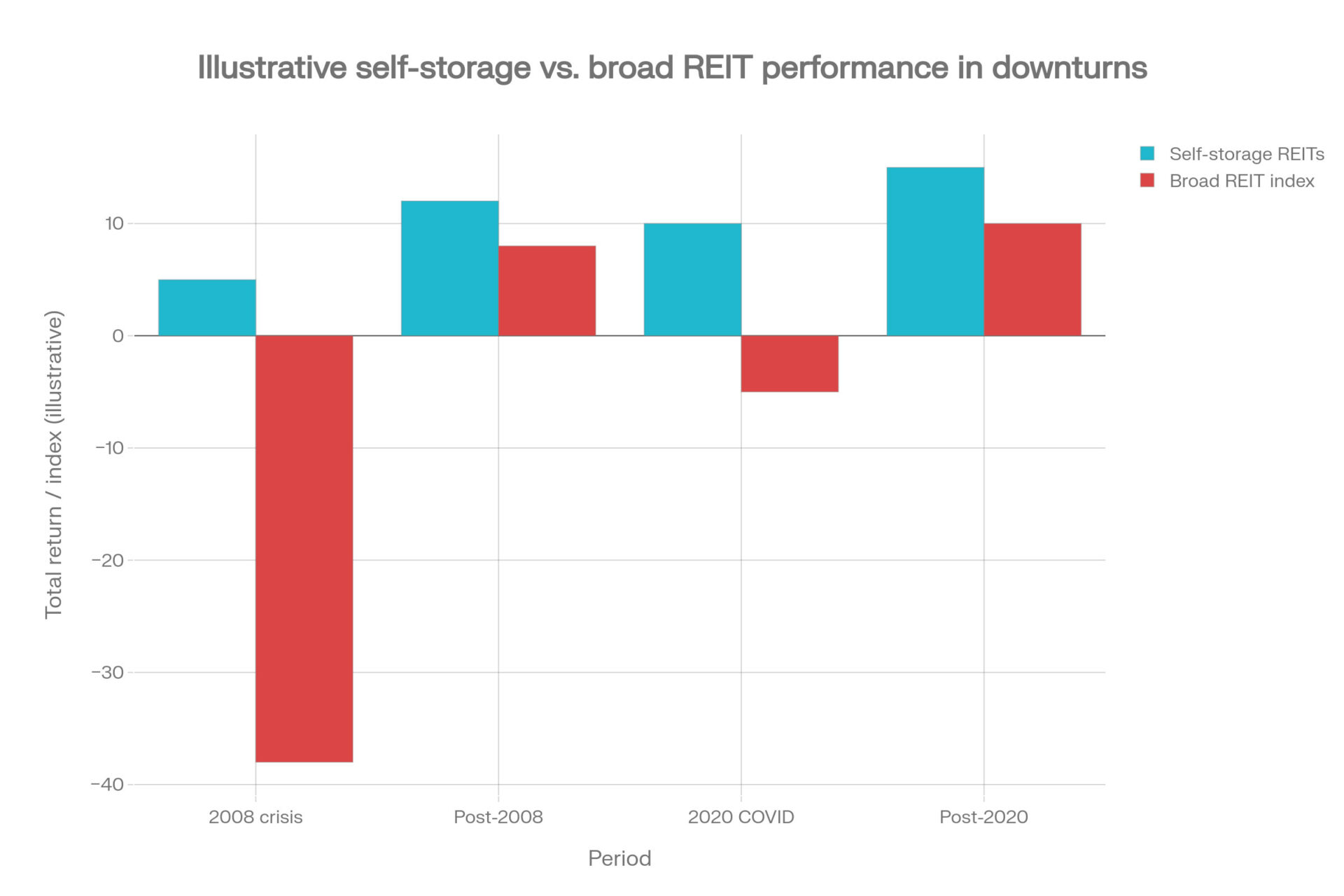
Historical data highlights a significant performance gap during the Great Recession. While the broader equity REIT index saw deep negative returns, self-storage REITs were among the only real estate sectors to post positive total returns in 2008.
At the property level, occupancy and revenue proved more durable than in the office, retail, or hospitality sectors, which faced both plummeting demand and long-term lease exposure.
While individual asset performance varied, the sector did not experience a universal reprieve from the 2008 crisis. However, on an aggregate basis, self-storage demonstrated significantly greater resilience than most other real estate categories throughout the downturn.
The COVID-19 Shock and Recovery
Following a brief window of uncertainty in early 2020, self-storage experienced a rapid, record-breaking recovery.
As remote work, household relocations, and “decluttering” trends accelerated, many markets saw record‑high occupancies and rapid rent growth in 2020-2022. National asking rents reached an all‑time high around the third quarter of 2022 before gradually normalizing.
Again, while national asking rents have since normalized, this cycle underscored the sector’s ability to pivot and thrive under shifting social and economic conditions.
The Shift to Institutional Maturity
Self-storage is no longer a “niche” asset class. Over the last decade, consistent performance has attracted massive inflows of institutional capital and large-scale real estate funds. This surge in professional interest has accelerated sector consolidation and the development of sophisticated management platforms that prioritize data-driven operations.
For the passive investor, this shift represents a move away from the “mom-and-pop” era into a mature, transparent market. You aren’t just investing in a building; you are partnering with professional operators who use institutional-grade technology and scale to navigate complex economic cycles.
Where Risk Still Exists
Resilience is not a synonym for “risk-free.” While the asset class has historically demonstrated greater demand durability than other property types, that macro-resilience does not guarantee individual deal success. Investors must still account for specific variables that can dictate the outcome of a project regardless of the broader economic climate.
Hyper-Local Oversupply
Self-storage demand is local. While the national outlook may be strong, aggressive new development in specific metros can quickly saturate a submarket. When supply outpaces local demand, operators are forced into “rent wars” and extended lease-up periods. For the passive investor, a rigorous, three-mile-radius supply-demand paired with an appropriate drive time analysis is a necessity, not a luxury.
Execution and Operational Alpha
Self-storage is an operationally intensive business. Performance is driven by daily decisions in dynamic pricing, digital marketing, and cost control. A well-located asset managed by a weak platform will consistently underperform. Evaluating a sponsor’s operational infrastructure is just as critical as evaluating the estate itself.
Capital Markets and Interest-Rate Sensitivity
No asset class is immune to the cost of capital. Rising interest rates compress cap-rate spreads and can diminish exit valuations. Deals underwritten with aggressive terminal cap rates or short-term, floating-rate debt face significant “refinance risk” if the credit environment shifts. Conservative debt structuring is the primary defense against this volatility.
Development and Lease-Up Risk
Ground-up development offers higher potential upside but carries a fundamentally different risk profile than stabilized acquisitions. A new facility starts at zero occupancy; its success depends entirely on the accuracy of lease-up projections. If a pro-forma assumes aggressive rent growth in an increasingly competitive market, the actualized returns will fall short of the forecast.
How a First Time Passive Investor Should Use “Recession Resistance”
The historical resilience of self-storage is a powerful tool for wealth preservation, provided it is applied with precision. For the disciplined investor, the goal is to verify that a specific opportunity is engineered to capture that inherent asset-class strength.
For a first‑time passive investor, that means:
- Identify local market strength: Focus on submarkets where demand is fundamentally underserved. Look for signs of healthy friction, where high occupancy and steady rent trends confirm that the local market has the capacity to absorb existing and future supply.
- Partner with proven expertise: Seek out operators who have successfully navigated various market cycles. A track record of active management during shifting environments is a strong indicator of a team’s ability to protect and grow investor capital when conditions change.
- Verify conservative underwriting: High-quality deals are often built on “stress-tested” foundations. Reviewing scenarios where occupancy or exit caps are adjusted allows you to see the margin of safety designed into the project to ensure it remains viable across a range of outcomes.
- Confirm structural alignment: A clear, transparent investment structure, from the waterfall to the debt terms, ensures that the interests of the sponsor and the investor are aligned toward long-term stability and success. “Recession resistance” is a characteristic of the asset class in the aggregate. Whether it translates into the outcome of your particular investment depends on underwriting discipline, operator execution, and market selection. Those are the levers worth examining carefully.
How a Disciplined Sponsor Fits In
Cycle-tested sponsors operate with the understanding that market conditions are dynamic. Rather than relying on favorable tailwinds, they build resilience directly into the deal’s architecture.
This proactive approach is defined by institutional best practices: conservative leverage, data-backed lease-up timelines, and rigorous sensitivity analysis for rents and cap rates. High-tier operators prioritize active asset management, treating every facility as a living business that requires constant optimization rather than a “set-it-and-forget-it” investment.
A sponsor who prioritizes transparency, openly discussing stress-test scenarios alongside growth projections, demonstrates true alignment with long-term investors. By moving beyond the “recession-resistant” label and focusing on operational discipline, these sponsors create a pathway for investors to access private markets while participating in the asset class’s long-term characteristics.
Ready to Deploy Capital with Spartan?
The “recession-resistant” advantage is only as strong as the operator behind the deal. Join the Spartan investor community to access institutional-grade self-storage opportunities engineered for resilience and long-term growth.
Ready to learn more?
Speak with our investor relations team. Review current offering materials.
investors@spartan-investors.com
Disclaimer:
This guide is for informational and educational purposes only and does not constitute an offer to sell or a solicitation of an offer to buy any security. While self-storage has historically demonstrated demand-resilience during economic downturns, past performance is not a guarantee of future results.
All real estate investments involve significant risk, including the potential loss of principal. Economic resilience at the asset-class level does not ensure the success of any individual investment. Any specific offering is made solely through a Private Placement Memorandum (PPM) pursuant to Rule 506(c) and is restricted to verified accredited investors. Please consult with qualified legal, tax, and financial advisors before committing capital.