

Mid-Year Storage Investor Letter
At mid-year, the best place to start is with the facts. SIG’s operating portfolio includes 89 self-storage assets, approximately 44,900 units and 6.55 million rentable square feet across 15 states.
Those are meaningful numbers. They also do not tell the whole story. Some assets are producing strong cash flow today. Others are still leasing up, completing construction, absorbing higher interest expense or working through property-specific issues. That is the nature of a portfolio built across different vintages and business plans. The job is to know where each property stands, what is driving the result and what the team is doing next.
That is how I have always preferred to discuss the business. Facts first. Self-storage is a simple business, but it is not an easy business. We rent small spaces, one customer at a time, and success comes from doing hundreds of ordinary things well: answering the phone, converting leads, controlling discounts, collecting rent, keeping the property clean, managing expenses and financing the asset sensibly.
A good operator does not need every property to be perfect. A good operator needs to know exactly which properties are working, which are not, and what is being done about each one.
The Spartan Platform at Mid-Year
Spartan began in 2014 and has grown into a national self-storage platform with nearly $1 billion in assets, more than 43,000 storage units and six consecutive appearances on the Inc. 5000 list. The operating footprint now stretches across 15 states, with the largest concentrations in the South, Texas and the Pacific Northwest.
Scale matters, but only when it improves execution. SIG’s advantage is not merely that it owns storage. The company is vertically integrated across acquisitions, development, construction management, asset management and property operations through FreeUp Storage. That structure gives the team direct visibility into the entire business plan, from finding the site and building the facility to setting rental rates and answering the customer’s call.
It also removes the convenient excuse of blaming a third party. When performance falls short, the issue sits inside the same organization responsible for fixing it. As an operator, I want that accountability. I would rather own the problem and solve it than spend time explaining why someone else did not.
| Mid-Year Operating Snapshot | April 2026 T-4 Run Rate |
|---|---|
| Operating assets | 89 |
| Storage units | Approx. 44,900 |
| Rentable square feet | 6.55 million |
| States | 15 |
What Is Working
Several stabilized assets continue to demonstrate what the storage model can look like when occupancy, rental rates and the capital structure are aligned. Corsicana, Sharpsburg, St. Marys Industrial Drive, Phenix City, Lake Stevens and South Broadway were among the stronger cash-flow contributors on the April run rate.
The operating team has also continued to make practical financing improvements. Spartan Storage Fund I completed a cash-out refinance at the Opelika facility, and the proceeds were used to reduce debt at the fund level. Louisville completed a loan modification that lowered property-level interest expense by approximately $2,700 per month. Neither item makes a dramatic headline. Both improve the economics.
The broader portfolio continues to benefit from geographic diversity. Roughly 37% of portfolio NOI is generated in the South and 33% in Texas, with additional exposure across the Pacific Northwest, Florida, the Midwest and the Mountain West. Storage demand is local, so no national percentage replaces property-level execution, but a broad footprint does reduce dependence on one city, one employer or one regional economy.
Where the Work Remains
Some facilities remain in development or lease-up and are doing exactly what early-stage assets often do: consuming cash before reaching stabilization. Others are carrying debt structures that became more expensive as rates moved higher. A smaller group has specific operating issues that require direct intervention, including units taken offline, delayed occupancy approvals or slower-than-planned leasing.
There is no value in lumping those situations together and calling them “market conditions.” Each asset has its own cause and its own corrective plan. The team’s job is to improve occupancy, grow effective rent, reduce unnecessary concessions, convert more leads, control operating expenses and address debt maturities before they become emergencies.
The business plan is not a PowerPoint deck. It is the weekly list of problems that must be solved.
The Self-Storage Market
Self-storage is often described as recession resistant. That is directionally true and frequently oversold. People continue to need storage during moves, divorces, job changes, home renovations, military deployments and business transitions. Those demand drivers do not disappear because the Federal Reserve changes interest rates.
What does change is the price of debt, the pace of new construction and the amount a buyer can responsibly pay. The easy-money period rewarded aggressive leverage and optimistic exit assumptions. The current market is less forgiving. That is healthy for disciplined buyers, provided they remain disciplined.
New supply remains the variable that matters most at the local level. A market can have strong population growth and still be a poor storage market if too many facilities are built at once. Conversely, an ordinary market with limited new supply can produce excellent economics. SIG’s underwriting therefore starts with the trade area, not the national headline.
Development and New Investment
We continue to pursue both acquisitions and development, but the standard remains the same: a project must work under today’s financing and construction assumptions, not the assumptions we wish still existed.
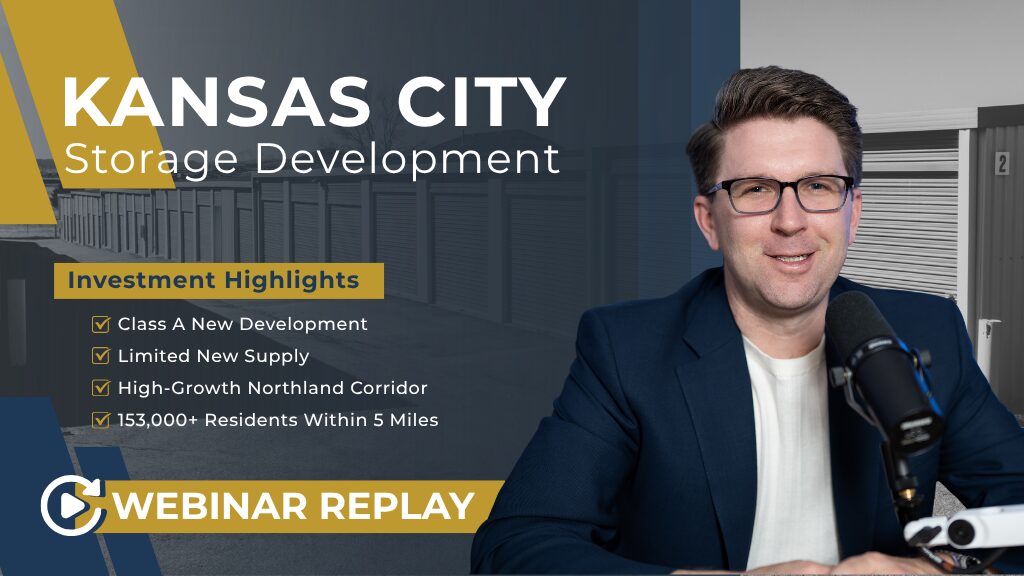
Our latest self-storage development in Kansas City is a useful example. The property includes approximately 64,575 rentable square feet and 551 units across five single-story buildings. The thesis is straightforward: a growing trade area, limited immediate storage supply, entitlements that required roughly four years to secure and a business plan we’ve executed many times over. Spartan Construction Management is developing the facility and FreeUp Storage will operate it. Accredited investors can learn more by visiting the deal room.
Communication and Accountability
Investors deserve communication that is specific to their investment. A general market discussion is useful, but it does not answer why one property is distributing and another is not. Our monthly updates are being rebuilt around that principle: current operating results, performance against the original business plan, what management is doing now and what investors should watch next. That is the same information I want when I am sitting in an investment committee meeting reviewing an asset.
We will not always have good news to report. We should always have a clear answer. The standard is not perfection. The standard is transparency, competent action and measurable progress.
Spartan was founded on a simple idea: buy and build assets we understand, operate them with discipline and stay accountable to the investors who trusted us with their capital. I have been involved in this business from the first deal through the platform we operate today. I have walked the sites, reviewed the underwriting, raised the capital, worked through construction problems and sat across the table when results did not match the original plan. That experience shapes how I view investor communication. You should hear from the people responsible for the decisions, and the explanation should be clear enough to understand without a finance degree.
The Second Half of 2026
Our priorities for the balance of the year are not complicated:
- Push lease-up assets toward stabilization with better lead conversion, pricing discipline and local execution.
- Protect liquidity and improve property-level debt-service coverage.
- Complete refinancing and loan-modification work where the economics justify it.
- Finish construction and obtain occupancy approvals without sacrificing quality for speed.
- Cull distractions, focus capital on the best risk-adjusted opportunities and communicate plainly when results differ from the plan.
Good real estate investing is not about pretending risk does not exist. It is about buying with a margin for error, operating with urgency and telling investors the truth while the work is being done. That has been our approach from the beginning, and it remains the standard I expect from the team.
The first half of 2026 gave us examples of both sides of the business: stabilized facilities producing dependable cash flow and developing assets that still require time, capital and execution. That mix is the portfolio today. We know where the work is. We have built the operating platform to do it. The second half of the year is about execution, one property and one decision at a time.
Sincerely,
Ryan Gibson
Co-Founder & Chief Investment Officer
Spartan Investment Group
Operator first. Investor aligned.