


Short-Term vs. Long-Term Real Estate Investing: Which Strategy Is Right for You?
Syndicated commercial real estate offers unique passive income opportunities for every kind of investor. But choosing the right time horizon, and the right asset class, matters more than ever in today’s market.
Real estate syndications allow individual investors to pool capital and access large-scale commercial properties that would otherwise be out of reach.1 The appeal is significant: syndications can deliver passive income, portfolio diversification, and potential tax advantages through structures like depreciation and preferential capital gains treatment.2
However, investors routinely face one of the most consequential decisions in their strategy: should you target a short-term or long-term hold? Both approaches can generate strong returns, but deciding which suits you comes down to two fundamental factors: time horizon and risk tolerance.
Short-term syndication strategies (generally those with hold periods under three years) can be enticing for their quicker returns and faster capital recycling. But the upside potential and the downside risk move together.
Before committing to a short-term investment, experienced investors carefully evaluate the opportunity cost. Ask yourself:

The Recession Risk Factor
A critical consideration for short-term investors is economic sensitivity. Short holds leave little room for recovery if market conditions deteriorate during the investment period. During recessions, low liquidity is one of the most significant hazards: with fewer buyers in the market, exiting a short-term position at target price becomes materially harder.5
The risks are not abstract. At the time of publication, J.P. Morgan Research placed recession odds at below 40%, while Moody’s estimated them between 50% and 60%6 (figures that may shift as economic conditions evolve). Even a mild downturn can compress valuations and delay exits. Short-term investors who are forced to sell in a down cycle typically receive lower returns than originally projected.
Short-term real estate investments carry amplified recession risk. Unlike longer holds, which provide the runway for a market to recover, short positions can lock investors into unfavorable exit windows with limited resources.
Data also shows that speculative and high-risk short-term deals tend to attract investor capital ahead of economic downturns, when credit loosens and appetite for yield rises. Investors who over-leverage or chase outsized short-term gains in this environment are often the most exposed when conditions shift.7
Long-Term Real Estate Investing
Long-term strategies (typically five years or more) are generally better suited for investors seeking lower volatility, stable distributions, and meaningful appreciation at exit. The extended time horizon allows operators to execute complex business plans, weather market cycles, and maximize the compounding of property value improvements.
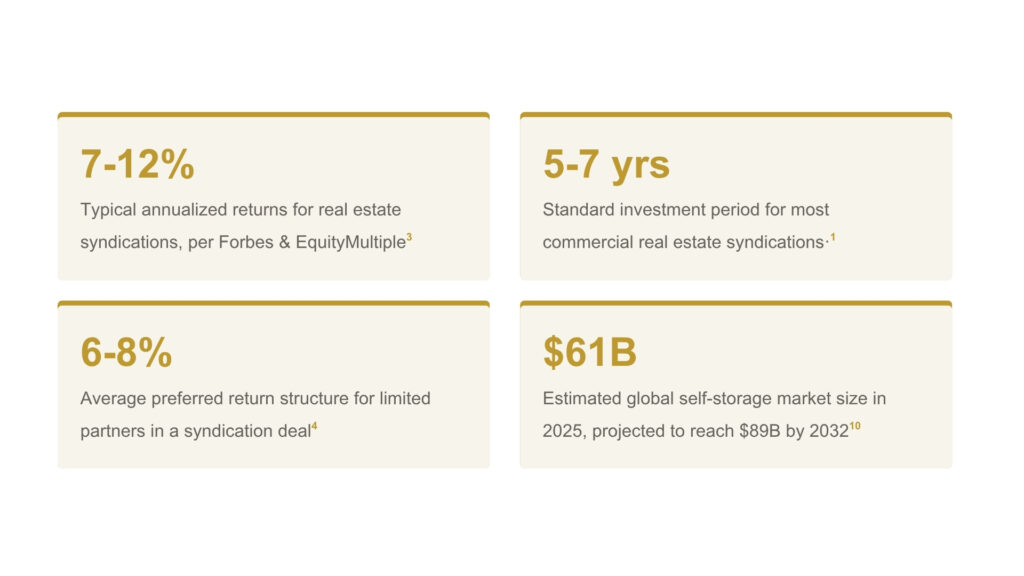
Preferred returns for long-term syndications are typically structured at 6-8% annually, with a 70/30 or 80/20 LP/GP profit split above that hurdle.4 This structure prioritizes investor capital and income before the sponsor earns carried interest, a meaningful alignment of incentives over a multi-year period.
Matching Time Horizon to Business Plan
The most important question long-term investors can ask is: does this investment’s timeline match my financial objectives?
Consider a value-add self-storage development where the initial construction or repositioning phase alone could take 18 to 24 months. In this scenario, a long-term hold allows the investor to participate in the full arc of value creation, from stabilization through lease-up to a well-timed exit. Truncating that timeline sacrifices appreciation that compounds meaningfully in later years.
Long-term self-storage investments also benefit from powerful structural demand tailwinds. Population growth, urbanization, and increasing mobility have made storage a need-based service that performs across economic conditions. With over 50,000 facilities and more than 2.1 billion square feet of rentable space across the U.S., self-storage has matured into a mainstream institutional asset class with proven cash flow stability across economic cycles.12
Long-Term Investing and Recession Resilience
Self-storage stands apart from most commercial real estate asset classes when it comes to economic downturns. It was the only commercial real estate asset type to generate positive returns throughout the Great Recession of 2008, a distinction no other sector can claim.8 The reasons are structural: demand for storage tends to increase during recessions as people downsize, relocate, and navigate life transitions, the very events that drive occupancy regardless of broader economic conditions.
The sector continues to demonstrate durable cash-flow characteristics in the current cycle. As of mid-2025, self-storage cap rates averaged 5.8%, transaction volumes normalized at approximately $2.85 billion in H1 2025, and approximately $3 billion was invested in the sector in 2024 alone, even amid broader commercial real estate volatility9,11
Long-Term Investing with Spartan Investment Group
For investors seeking consistent, passive income backed by one of the most resilient commercial real estate asset classes, the Spartan Storage Debt Fund offers accredited investors a straightforward way to participate in Spartan’s growing self-storage portfolio.
The global self-storage market is valued at approximately $61 billion in 2025 and is projected to grow at a compound annual rate of 5.6% through 2032.10 That growth is underpinned by durable demand drivers, including urbanization, population mobility, e-commerce expansion, and the persistent undersupply of quality storage facilities in key U.S. markets.12
The Spartan Storage Debt Fund is a $60 million fund that issues notes to accredited investors, with proceeds deployed across Spartan’s vetted ground-up, lease-up, and value-add self-storage projects nationwide. As a debt investor, you benefit from immediate and consistent monthly cash flow in a lower-risk structure, with a redemption option available for those seeking added flexibility.
Sources:
- Valiance Capital, “Real Estate Syndication: The 2025 Accredited Investor’s Guide,” February 2025. valiancecap.com
- Primior Group, “Real Estate Syndication in 2025: What Smart Investors Need to Know,” June 2025. primior.com
- Gatsby Investment, “How Much Can You Make with Real Estate Syndication?,” March 2025. gatsbyinvestment.com
- Syndication Attorneys LLC, “What Returns Do Real Estate Investors Want in 2025?,” April 2025. syndicationattorneys.com
- WealthArc, “Is Real Estate Worth Investing During Recession?,” May 2025. wealtharc.com
- J.P. Morgan, “Commercial Real Estate and a Potential Recession,” 2025. jpmorgan.com
- Vinovest, “Recession Proof Real Estate Investing: Is It A Good Idea In 2025?,” 2025. vinovest.co
- Reliant Management, “How to Build a Real Estate Portfolio That Is Recession-Proof,” 2023. reliant-mgmt.com
- CRE Daily / Cushman & Wakefield, “Self Storage Market Trends Show Signs of Stabilization in 2025,” September 2025. credaily.com
- Coherent Market Insights, “Self-Storage Market Revenue Growth 2025 and Forecast to 2032,” 2025. coherentmarketinsights.com
- Mordor Intelligence, “Self Storage Market Size, Trends, Share & Forecast Report 2030,” 2025. mordorintelligence.com
- StorageCafe, “Self Storage Industry Statistics,” January 2026. storagecafe.com